High temperature, fine dust, smoky air, chemical odors, raw material odors, etc. are the causes that have negative effects on health, as well as directly reduce the productivity of employees working in factories. To solve this problem, businesses have installed factory ventilation systems as an optimal and effective solution to solve the problem of air pollution in the space of factories and manufacturing plants.
1. Current status of air pollution in factories
Factories are places where a large number of workers work in the same space. Therefore, the amount of CO2 emitted is very large. Along with that is the high heat from operating machines, as well as industrial dust, chemical odors, raw material odors, etc.
This overall has made the environment inside the factory polluted and lacking in oxygen, making the people working inside easily feel stuffy, short of breath and tired. This has a negative impact on the health of the workers, causing a significant decrease in labor productivity. On the other hand, the factory space is always a closed space. Therefore, the natural air circulation in the space is also somewhat more difficult.
To solve this problem, businesses need to invest in an optimal factory ventilation system to improve the air quality inside the factory most effectively.
2. Optimal benefits that factory ventilation systems bring
Faced with the huge impacts of air pollution on the health and productivity of workers, building a factory ventilation system is an ideal and optimal choice. An industrial ventilation system for factories will bring businesses many benefits such as:
- Ensure that the air inside the factory is always circulated and exchanged.
- When combined with an industrial ventilation fan system, the air inside will be cleaned and exchanged with the natural air outside.
- Provide fresh wind and natural air, ensuring health for workers.
- Cooling for equipment and machinery.
- Cleans the air, eliminates excess heat, balances humidity, and provides the necessary amount of air for internal activities.
- In special environments, ventilation systems also help to overcome problems of toxic substance leakage during production operations.
- Helps businesses save more costs compared to using conventional air conditioning systems.
3. 4 types of optimal ventilation systems for factories
3.1. Natural ventilation system
This is a simple ventilation method, because it is cheap, it is used quite commonly. This system works based on the difference in air pressure between the inside and outside of the workshop. From there, it creates a natural wind flow into the workshop space.
To implement this type of ventilation, many methods can be used such as: windows, skylights, ventilation louvers, vents, etc. During construction and installation, the louvers can be placed with two ends to take in air and push air, to optimize air circulation efficiency.
Natural ventilation is often suitable for small and medium sized spaces. Suitable for factories that produce a lot of dust such as: wood production, mechanical processing, raw material processing, etc.
Advantage:
- Simple, easy to install.
- Save electricity.
- Low investment cost.
- Does not produce emissions and wastewater that pollute the environment.
Disadvantages:
- Depends a lot on natural factors: wind direction, wind speed,...
- Low air transmission efficiency.
3.2. Factory ventilation using roof fan system
This is a ventilation system using exhaust fans installed on the factory roof. There are many types of roof fans to choose from such as: centrifugal fans, roof exhaust fans, axial fans, etc.
This system will draw fresh air from outside and distribute it evenly throughout the interior space. At the same time, thanks to the pressure difference, the system also helps push polluted air out through the louvers and windows.
With this method, the ventilation efficiency is much higher than natural ventilation. However, the roof fan system is only suitable for factories, warehouses or production areas with high heat emissions.
Advantage:
- Roof mounted ventilation fans are often durable and long lasting. Withstands many weather conditions well.
- Low initial investment cost.
Disadvantages:
- The air flow generated on the device is still low, so the efficiency is not too outstanding.
- It takes a lot of time to calculate the required air flow, number of fans, suitable fan type, etc.
3.3. Factory ventilation using Cooling Pad system
It is a ventilation solution for fast cooling performance and cost savings. This ventilation system will use a continuous water pump to the Cooling Pad to form a cooling water film. When passing through this water film, the air will be quickly cooled by the water, becoming a cool air flow inside the factory.
This system can be used for most types of spaces. However, if the factory belongs to fields such as electronics, food, chemicals, etc., this system is not suitable due to the increased humidity.
Advantage
- Fast cooling performance.
- Save investment and operating costs for businesses.
- Do not use a variety of machinery and equipment.
Disadvantages:
- Increases humidity in the air inside the space.
- Not suitable for factories with many modern electronic machines.
3.4. Factory ventilation using duct system (air duct)
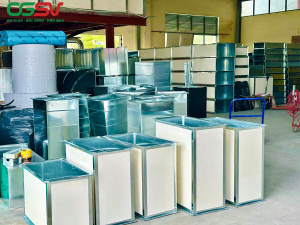
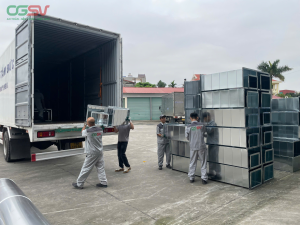
Is one of the most popular factory ventilation systems that is currently the most preferred choice of many business owners. With this system, fresh air will be drawn from the outside by fans into the filter system for cleaning. Then the supply air duct system will be transmitted to the locations that need to be supplied through the air vents. At the same time, the return air duct system will suck polluted air and excess heat out. Helps keep the factory air always fresh and clean.
In particular, when combined with a central air conditioning system, it will create a perfect and optimal factory air conditioning and ventilation system.
Factory ventilation using industrial duct systems can be suitable for most production spaces: pharmaceuticals, food, electronic components, etc., so it is being applied in many different factories.
Advantage:
- Easy to operate mechanism.
- Installation investment costs are not too high.
- High ventilation and cooling efficiency
- Suitable for many factory spaces.
Disadvantages:
- It is necessary to calculate and select the type and number of fans to use.
- Time consuming to install.
Above are some outstanding and effective ventilation systems that are being applied in industrial factories today. If you need to find a professional and reputable unit for manufacturing, constructing and installing air ducts in Hai Phong, please contact us. With the motto "Building trust through quality", Sao Viet Air Duct is confident that it can satisfy customers.
SAO VIET AIR DUCT MANUFACTURING AND TRADING COMPANY LIMITED
– Address: 267 Le Thanh Tong, May Chai, Ngo Quyen, Hai Phong
– Hotline: Mrs. Hang 0985 239 838, Mrs. Giang: 0934 559 168
– Phone: 0225 355 5619
– Email: dieuhoasaoviet@gmail.com
– Facebook: https://www.facebook.com/dieuhoasaoviet68