In the context of modern industrialization, factories and production plants not only focus on increasing productivity but also pay special attention to the working environment. One of the key factors in ensuring the health of workers and the durability of machinery is... factory ventilation system. This is considered the "lungs" of every industrial building, helping to regulate the air, remove dust and toxic gases. This article will provide a comprehensive view of the types, technical standards and the reasons why factory ventilation system so important to your business.
1. What is a factory ventilation system and why is it necessary?
1.1. Basic Concepts
Factory ventilation system It is a collection of equipment and technical solutions installed to circulate air, replacing the polluted, hot air inside the factory with fresh, clean air from the outside. This process is not simply about cooling but also includes controlling humidity, filtering dust, and removing harmful emissions generated during production.
1.2. Current environmental conditions in factories and workshops
Factories are places where a large number of workers and machines operate continuously. This leads to the accumulation of large amounts of CO2, heat emitted from equipment, industrial dust and chemical odors. Without factory ventilation system If the air is not working properly, the space will become stuffy and lack of oxygen. This situation, if prolonged, will cause serious problems such as:
-
Workers' health: Prone to respiratory diseases, fatigue, dizziness due to lack of oxygen and heat shock.
-
Machine performance: High temperatures reduce the lifespan of electronic components, causing malfunctions and disrupting production lines.
-
Product quality: Unstable humidity and temperature can denature raw materials or damage finished products (especially in the food and pharmaceutical industries).
1.3. Core benefits of installing a factory ventilation system
Invest in one factory ventilation system A systematic approach offers a double benefit for businesses:
-
Improve working environment: Helps keep the air fresh, reduces temperature by 5-10 degrees Celsius compared to outside, creating a comfortable feeling for workers.
-
Increase labor productivity: A cool environment helps employees concentrate better, reducing sick leave and work accidents.
-
Cost savings: Compared to installing air conditioning throughout the entire factory, factory ventilation system (especially negative pressure cooling or natural ventilation) have much lower investment and operating costs.
-
Compliance with the law: Meet regulations on occupational safety and hygiene and environmental protection according to Vietnamese standards.
2. Classification of the 4 most common factory ventilation systems currently in use.
Depending on the scale, production characteristics and budget, businesses can choose one of four types. factory ventilation system popular below.
2.1. Natural ventilation system
This is the simplest and most economical method. Factory ventilation system Natural form works based on the principle of pressure and temperature difference between inside and outside the factory (chimney effect).
-
Structure: Use windows, doors, skylights, or louvers that are properly arranged to catch wind and release hot air.
-
Advantage: The investment cost is virtually zero, it doesn't consume any electricity to operate, and it's environmentally friendly.
-
Disadvantages: Efficiency depends entirely on weather and wind direction. Limited cooling capacity, cannot filter dust. Only suitable for small workshops with little heat and dust generation.
2.2. Roof Fan Ventilation System
Factory ventilation system Using roof exhaust fans is a forced, proactive solution to draw out hot air that has accumulated on the factory ceiling and expel it outside.
-
Mechanism: Fans (usually axial or centrifugal) are mounted on the roof top. When operating, the fan creates negative pressure, sucking hot air up and pushing it out, while fresh air is brought in through windows or vents below.
-
Advantage: High durability, withstand harsh weather. Solves the problem of heat accumulation in the roof area. Low investment cost.
-
Disadvantages: Local air flow, cooling efficiency is not uniform throughout the factory. Need to carefully calculate the number of fans to achieve the desired efficiency.
2.3. Combined ventilation and cooling system (Cooling Pad)
This is a negative pressure cooling method, which is very popular in garment factories, shoe factories, and livestock farms.
-
Mechanism: One end of the factory is equipped with a high-powered industrial exhaust fan system, while the opposite end features cooling pads that are continuously sprayed with water. When the exhaust fan is operating, hot outside air passes through the water film, instantly reducing its temperature (due to water evaporation) before entering the factory.
-
Advantage: Very high cooling efficiency (deep heat reduction), operating cost is only 1/10 compared to air conditioning.
-
Disadvantages: It increases the humidity in the air. Therefore, factory ventilation system This form is not suitable for industries producing electronic components or dried foods that require low moisture content.
2.4. Duct ventilation system (Air duct system)
This is the most professional and flexible solution, often advised by Sao Viet Air Duct for large-scale factories or factories with high requirements on air quality.
-
Mechanism: Use fresh air supply fans (or coolers) connected to the duct system (square duct, spiral duct) to distribute air to each specific working position. At the same time, it can be combined with the return duct system to extract dust and exhaust gas at the source.
-
Advantage: Precise control of air flow in each area. Can combine filters to clean the air. Suitable for all types of factories from mechanical, pharmaceutical to electronic clean rooms.
-
Disadvantages: Investment and installation costs are higher than the above methods. Construction technical requirements are strict (SMACNA, TCVN standards).
3. Standards for design and construction of factory ventilation systems
To one factory ventilation system To operate efficiently and safely, the design and construction must strictly comply with domestic and international technical standards.
3.1. Vietnamese Standards (TCVN)
-
TCVN 5687:2010: Standards for the design of ventilation and air conditioning systems. This standard specifies the calculation parameters for the fresh air flow rate required per person (typically 20-30 m3/h/person), air cleanliness, and noise limits.
-
TCXD 232:1999: Regulations on the manufacture, installation, and acceptance of ventilation systems. This standard provides detailed guidance on duct materials (galvanized steel, stainless steel), sheet metal thickness, flange specifications, and duct support methods.
3.2. International Standards
-
SMACNA (USA): This is the "bible" in the duct manufacturing industry. The SMACNA standard specifies duct construction requirements to ensure rigidity, airtightness, and wind pressure resistance. factory ventilation system SMACNA certified will minimize air leakage and vibration during operation.
-
ASHRAE: The standards of the American Society of Heating, Refrigerating and Air Conditioning Engineers provide guidance on indoor air quality (IAQ) and energy efficiency.
3.3. Factors to consider when designing
When designing factory ventilation system, engineers need to carefully calculate the following factors:
-
Air Change Rate: Number of air changes per hour. For normal factories it is 3-6 times/hour, but for factories that generate a lot of heat or chemicals it can be up to 30-60 times/hour.
-
Installation location: Avoid placing the air vent directly on the worker to avoid localized cooling. The exhaust air intake must be located near the source of pollution.
-
Duct material: Galvanized steel ducts (Z080 or higher) are commonly used. For corrosive environments, stainless steel ducts should be used. For fire protection requirements, fire-resistant ducts (EI) should be used.
4. The role of air ducts in factory ventilation systems
In the structure of a factory ventilation system In modern times, the duct system acts as blood vessels, transporting air to the right place. The quality of the duct directly determines the performance and noise level of the entire system.
4.1. Square and rectangular air ducts
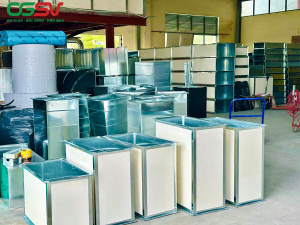
This type is often used as main pipelines in factory ventilation system Due to the large cross-section, it is easy to manufacture and install accessories (air valves, air vents). At Sao Viet Air Duct, square air ducts are manufactured on a modern Autoline production line, ensuring precise dimensions and tight seams.
4.2. Spiral round air duct
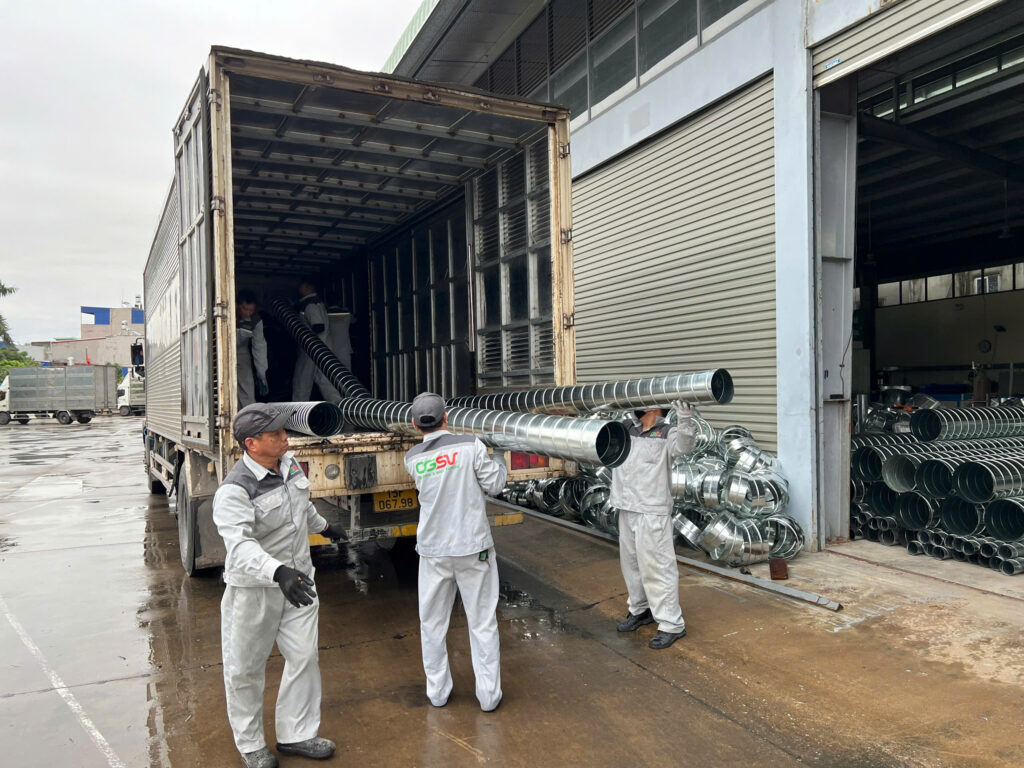
Spiral round air ducts are increasingly popular due to their high aesthetics, outstanding durability and ability to reduce air flow pressure loss. factory ventilation system, spiral round pipes are often used as branch pipes or open ventilation systems (no ceiling) to create architectural accents.
4.3. Fire-resistant duct (EI)
Meet QCVN 06:2020/BXD standards on fire safety for houses and buildings, factory ventilation system Currently, the use of fire-resistant ducting (EI30, EI45, EI60, etc.) is mandatory for emergency smoke extraction systems and stairwell pressurization. This is a solution to protect lives and property in the event of a fire.
5. Professional factory ventilation system installation process
A standard installation procedure will ensure factory ventilation system smooth and durable operation
-
Field survey: Measure the factory dimensions, determine the location of machinery, heat sources and main wind direction.
-
Design drawings: Calculate air flow, fan pressure, pipe size and layout schematic diagram on specialized software.
-
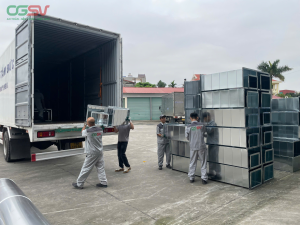
Manufacturing: We manufacture air ducts, dampers, and air vents in-house according to design specifications (this is a strength of Sao Viet Air Duct, with our factory located in Hai Phong).
-
Construction and installation: Install the support system, hang the duct, connect the fan and make electrical connections. Ensure compliance with occupational safety.
-
Test run and calibration (T&C): Measure air flow at the vents, check noise, vibration and handle leaks (if any).
-
Acceptance and handover: Operation and maintenance instructions for investors.
6. Why should you choose Sao Viet Air Duct for your factory ventilation system?
Choosing a consulting and construction unit factory ventilation system Reputation is the decisive factor for the quality of the project. Sao Viet Air Duct Trading and Manufacturing Company Limited (OGSV) is proud to be the leading unit in Hai Phong and the Northern region in this field.
6.1. Experience and Reputation
With over 15 years of experience in the HVAC industry, Sao Viet has participated in the construction of many projects. factory ventilation system large and small, from factories in industrial parks to commercial buildings such as Aeon Hai Phong. The OGSV brand is associated with the motto "Building trust with quality".
6.2. Direct production capacity
Unlike other intermediary trading units, Sao Viet owns a large-scale factory located at 267 Le Thanh Tong Street, May Chai Ward, Ngo Quyen District, Hai Phong. Our modern machinery system (Autoline machines, pipe bending machines, CNC Plasma cutting machines, etc.) allows us to:
-
Provide a complete package of products for factory ventilation system: Square and round air ducts, accessories, air valves, air vents.
-
Strict control of output quality.
-
Ensure fast delivery progress for the project.
-
Offer the most competitive prices due to direct production at the factory (original price).
6.3. Specialized technical services
Sao Viet does not just sell products, we provide solutions.
-
On-site measurement: Technical team is ready to come to the construction site to measure actual dimensions, helping to optimize materials and reduce errors during installation. factory ventilation system.
-
Design consulting: Support customers in designing fresh air supply and exhaust air systems to optimize energy and costs.
-
Diverse products: In addition to air ducts, we also provide industrial ventilation fans, ensuring synchronization for the entire system.
6.4. Quality Commitment and Warranty
All Sao Viet products use genuine galvanized steel (Hoa Sen, Hoa Phat) or high quality stainless steel. We commit to reputable warranty for all projects. factory ventilation system that we supply and construct, always accompany customers throughout the operation process.
7. Important notes when maintaining factory ventilation systems
To maintain performance and longevity of factory ventilation system, businesses need to perform periodic maintenance:
-
Clean the filter and cooling pad: Thick dust will reduce air flow and create a breeding ground for bacteria. Need to clean periodically every 1-3 months.
-
Check the fan belt: A loose or worn belt will reduce the fan's rotation speed, affecting ventilation efficiency.
-
Check the air duct: Detect and promptly handle tears and open joints on pipes. factory ventilation system to avoid pressure loss.
-
Engine lubrication: Make sure the fan runs smoothly and does not overheat.
Conclude
Invest in factory ventilation system This is a smart and sustainable investment for the future of the business. It not only helps protect the health of employees – the company's most valuable asset – but also ensures the stable and efficient operation of the production line.
With a wide variety of ventilation solutions ranging from natural to forced, businesses need to carefully consider and choose the most suitable option. If you are looking for a reliable partner to advise, design, and supply materials for your project... factory ventilation system in Hai Phong and neighboring provinces, Sao Viet Air Duct is the perfect choice.
Contact us now to create "Green Constructions - Green Future".
CONTACT INFORMATION – SAO VIET AIR DUCT MANUFACTURING AND TRADING COMPANY LIMITED
-
Address: 267 Le Thanh Tong, May Chai, Ngo Quyen, Hai Phong
-
Hotline: 0985 239 838 (Mrs. Hang) – 0934 559 168 (Mrs. Giang)
-
E-mail: dieuhoasaoviet@gmail.com / vietonggio@gmail.com
-
Website: onggiosaoviet.vn – dieuhoasaoviet.vn