In the context of strong urbanization and industrialization, indoor air quality (Indoor Air Quality - IAQ) has become a top concern. A clean living and working environment not only ensures health but also improves labor productivity. Acting as the "circulatory system" of every modern construction, the system ventilation duct is the key technical solution to solve this problem.
Whether it is an office building, a bustling shopping mall, or a large-scale industrial factory, the presence of a system ventilation duct is required to ensure air circulation, temperature control and removal of pollutants. However, not everyone clearly understands the structure, types and how to choose the right type of pipe for each specific purpose.
This article will provide a comprehensive and in-depth look at ventilation duct, synthesizing technical knowledge from basic to advanced, helping investors, engineers and end users have the most optimal choice for their projects.
1. Overview: What is ventilation and why is it important?
1.1. Definition of ventilation duct
Basically, ventilation duct is a system of pipes designed to conduct air flow from one location to another. It is an indispensable component in heating, ventilation and air conditioning (HVAC) systems. The main function of the system ventilation duct includes supplying fresh air (supply air), removing stale, contaminated air (exhaust air), and circulating heat-treated air (return air) within the enclosed space.
1.2. The role of "blood vessels" in modern construction
The importance of ventilation duct goes beyond the mere function of conducting air. It directly affects the following factors:
-
Air quality (IAQ): System ventilation duct Effective operation will help reduce CO2 concentration, remove dirt, bacteria, mold and volatile organic compounds (VOCs), providing fresh air.
-
Thermal comfort: Combined with air conditioning system, network ventilation duct Distributes cold or hot air evenly to every corner of the building, ensuring comfort for users.
-
Fire safety: In emergency situations, the system ventilation duct Specialized equipment (such as corridor exhaust pipes, stair pressurization pipes) plays a vital role in controlling smoke, helping residents escape safely.
-
Energy saving: A system ventilation duct The airtight, well-insulated design will minimize energy loss during air transportation, thereby reducing electricity costs for operating the HVAC system.
2. Ventilation Duct Classification: Detailed and In-depth
The market today offers a wide variety of ventilation duct different to meet diverse technical requirements. Classification is usually based on three main criteria: shape, material and function.
2.1. Classification by design shape
The shape of ventilation duct directly affects air flow performance, installation space and cost.
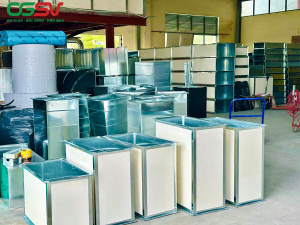
Rectangular Ducts
This is the most common type of pipe in commercial and residential buildings.
-
Advantage: Easy to manufacture to required dimensions, suitable for installation in narrow ceiling spaces thanks to the ability to utilize width and reduce height. Accessories such as elbows, tees, and adapters are very diverse.
-
Disadvantages: Aerodynamic efficiency is less than round tubes, prone to noise if poorly designed, and requires more material to achieve the same air flow than round tubes.
Spiral Round Ducts
Type ventilation duct This is made up of metal strips rolled in a spiral, creating a very sturdy structure.
-
Advantage: Outstanding aerodynamics, reducing air flow friction, thereby reducing pressure loss and noise. The spiral structure makes the tube more rigid, allowing the use of thinner materials while still ensuring durability. High aesthetics, often exposed to the ceiling in modern architectural designs (industrial style).
-
Disadvantages: Takes up more ceiling height space than flat rectangular tubes.
Longitudinal Seam Round Ducts
Unlike spiral tubing, this type has a weld or seam running along the length of the tube. It is often used for systems requiring extremely high air tightness or special industrial applications.
2.2. Classification by manufacturing materials
The material determines the durability, heat resistance, corrosion resistance and cost of the product. ventilation duct.
Galvanized Steel Ducts
This is the standard and most common material for ventilation duct. Galvanized coatings protect steel from rust under normal environmental conditions. They are cost effective, durable and easy to work with.
Stainless Steel Ducts
Used in harsh environments requiring high hygiene standards or strong corrosion resistance.
-
Application: Food processing plants, pharmaceutical clean rooms, chemical laboratories, or areas near the sea with salt vapor.
-
Characteristic: The cost is much higher than galvanized steel but the life and chemical resistance are superior.
Flexible Ducts
Usually made of aluminum foil combined with steel wire reinforcement, may have a layer of insulation cotton.
-
Advantage: Flexible, easy to bend to connect to air vents (air outlets) in hard-to-reach locations where rigid pipes cannot be installed.
-
Note: Because the inner surface is not smooth and prone to kinks, ventilation duct Soft hoses cause large pressure losses. They should only be used in short final connections (usually no more than 1.5m – 2m).
Fabric Ducts / Textile Ducts
A modern solution, often used in large spaces such as gymnasiums, supermarkets, cold storage. Air is blown through small holes or penetrated through the fabric surface, helping to distribute air evenly and not cause drafts.
2.3. Classification by function in the system
Based on the purpose of use in HVAC system, ventilation duct divided into:
-
Fresh air supply duct (Supply Air Duct): Bring in clean air from outside, usually through filters and a humidification system (AHU/PAU).
-
Return Air Duct: Air is drawn from the conditioned space back to the treatment unit for filtration and re-cooling/heating.
-
Exhaust Air Duct: Extract polluted air from toilets, kitchens, and production areas and release it into the outside environment.
-
Emergency Ventilation Duct: Including smoke exhaust pipe and stair pressurization pipe, can withstand high temperature for specified time to serve fire prevention work.
3. Multi-field applications of ventilation systems
The presence of ventilation duct spread across most types of construction.
3.1. Applications in industry and factories
Production environments often generate large amounts of heat, dust and toxic emissions. ventilation duct Industrial equipment is often large in size, using durable materials (such as stainless steel or thick galvanized iron) to:
-
Vacuum wood dust and metal dust at the source.
-
Cooling the factory by negative or positive pressure ventilation method.
-
Treat chemical emissions before releasing them into the environment.
3.2. Commercial and office buildings
In high-rise buildings, shopping centers, systems ventilation duct Often closely combined with central air conditioning systems (Chiller or VRV).
-
Ensure adequate oxygen supply for thousands of workers.
-
Control humidity to prevent mold.
-
System ventilation duct Smoke extraction in corridors and pressurization in elevator shafts are required to ensure fire safety.
3.3. Applications in civil and residential areas
On a smaller scale, ventilation duct still plays an important role:
-
Kitchen ventilation: Absorbs food odors and grease vapors through the hood and pushes them out.
-
Toilet ventilation: Eliminates odors and moisture, keeping the space dry.
-
Basement ventilation: Suction of vehicle exhaust (CO) and supply of fresh air to underground parking lots.
4. Golden criteria for choosing quality ventilation pipes
Choosing the wrong type ventilation duct can lead to poor system performance, loud noise, and wasted energy. Here are some criteria to consider:
4.1. Calculation of wind flow and velocity
Dimensions (cross section) of ventilation duct must be calculated based on the air flow to be transported and the allowable wind speed.
-
Too high wind speed will cause loud noise and high pressure loss.
-
Too low air velocity will increase the size of the pipe, causing waste of space and material costs.
4.2. Requirements for installation environment
-
If installed outdoors, ventilation duct Weatherproofing or good corrosion resistant material is required.
-
In chemical environments, it is mandatory to use stainless steel or specialized plastic pipes.
-
For cold air pipes, insulation (glass wool, vulcanized rubber) is required to prevent condensation and heat loss.
4.3. Tightness and manufacturing standards
System ventilation duct It is necessary to ensure tightness to avoid gas leakage. Reputable manufacturers (for example, professional units like Sao Viet) often comply with international standards such as SMACNA (USA) or DW144 (UK) on material thickness, flange connection specifications and processing methods to ensure tightness and structural strength.
4.4. Budget and aesthetics
Balance between initial investment costs and long-term operating costs. Sometimes investing in a system ventilation duct High quality spiral round pipes will save more energy in the long run than cheap but less efficient square pipes. For open ceiling spaces, the aesthetics of the pipe is also an important factor.
5. Basic notes on installation and maintenance
5.1. Technical standard installation
Installation process ventilation duct must strictly comply with the design drawings. Joints must be sealed with sealant or rubber gasket. The support system and suspension must be sturdy, ensuring standard distance to avoid pipe sagging. Pay special attention to the installation of air valves (VCD, OBD) and fire dampers (FD) in the correct position.
5.2. Periodic maintenance and cleaning
After a period of operation, dust and bacteria will accumulate inside. ventilation duct. This not only reduces air quality but also obstructs the flow, increasing the fan's power consumption. It is necessary to plan regular duct cleaning (using specialized cleaning robots) and check and replace air filters to ensure the system always operates optimally.
System ventilation duct Pipes are an integral part of modern engineering infrastructure. Understanding the types of pipes, materials and operating principles helps us make smart investment decisions, ensuring a safe, comfortable and energy-saving living and working environment.
When there is a need for system design, supply or installation ventilation duct, finding professional manufacturing and construction units with extensive experience in the field of HVAC and mechanical processing is a prerequisite to ensure sustainable construction quality over time. Prioritize standard products and dedicated technical services to optimize the efficiency of your investment.
CONTACT INFORMATION – SAO VIET AIR DUCT MANUFACTURING AND TRADING COMPANY LIMITED
-
Factory address: 267 Le Thanh Tong, May Chai, Ngo Quyen, Hai Phong
-
Hotline/Zalo:
-
Mrs. Hang: 0815.999.826
-
Mrs. Giang: 0934.559.168
-
Mrs. Linh: 0949.852.886
-
Tel: 0985.239.838
-
-
-
E-mail: vietonggio@gmail.com / dieuhoasaoviet@gmail.com
-
Website: onggiosaoviet.vn - dieuhoasaoviet.vn
Let Sao Viet Air Ducts be your partner in creating healthy and safe living spaces!