In the context of increasing urbanization and air pollution, ensuring indoor air quality (IAQ) is no longer a luxury but an urgent need. Closed-off townhouses and high-rise offices that use air conditioning continuously often face stuffiness, lack of oxygen and CO2 accumulation. The best solution to solve this problem is to install a ventilation system. This article will provide an in-depth look, consulting on fresh air supply diagram design scientifically and effectively, helping your living and working space to always be fresh and full of energy.
1. Why do we need professional fresh air supply design consultation?
Many people mistakenly believe that simply installing an exhaust fan or opening a window is enough to ventilate. However, these are passive methods and are ineffective in modern airtight architecture. Arbitrary installation without consulting on fresh air supply diagram design Incorrect installation often leads to the following situations: fresh air cannot reach where needed, loud noise, wasted air conditioning energy and even causes "backflow" of bad odors/mold.
1.1. Negative effects of being “starved” for fresh air
When a closed space is not supplied with enough fresh air, the concentration of Oxygen gradually decreases while CO2 and volatile organic compounds (VOCs) from furniture and cleaning chemicals increase.
-
For health: Causes “Sick Building Syndrome” with symptoms such as headaches, dizziness, fatigue, dry skin, eye and nose irritation and reduced concentration. In the long term, it affects the respiratory and cardiovascular systems.
-
For the living environment: Uncontrolled humidity leads to mold and bacteria growth, which damages furniture and creates unpleasant odors.
1.2. Core benefits of a precise fresh air supply diagram
A process consulting on fresh air supply diagram design professional, such as the solutions mentioned at dieuhoasaoviet.vn, will bring outstanding benefits:
-
Proactively control air quality: Ensures abundant oxygen, dilutes and repels CO2, fine dust, and bacteria from the living space.
-
Airflow optimization: The design diagram helps to accurately determine the supply and exhaust locations, ensuring fresh air circulates to every corner, avoiding dead zones.
-
Energy saving: Modern systems with integrated heat recovery (HRV/ERV) significantly reduce the load on the air conditioning system, saving operating energy.
-
Enhance the value of the project: A good ventilation system is an important criterion of green buildings and luxury real estate.
2. The “golden” principles in designing fresh air supply systems
To process consulting on fresh air supply diagram design To achieve maximum efficiency, engineers must adhere to basic engineering principles of gas dynamics and hygiene standards.
2.1. Pressure balance principle
Controlling indoor vs. outdoor pressure is key:
-
Positive Pressure: The amount of fresh air supplied is greater than the amount of air discharged. Usually applied to “clean” spaces such as operating rooms, laboratories, or living/sleeping rooms to prevent dust and polluted air from outside (or dirtier areas such as bathrooms) from entering.
-
Negative Pressure: The amount of exhaust air is greater than the amount of air supplied. Applicable to areas that generate a lot of pollutants and odors such as kitchens, toilets, and smoking rooms to prevent dirty air from spreading to other rooms.
-
Balanced Pressure: The amount of air supplied and discharged is equal. This is the ideal solution for most common living spaces and offices, helping to maintain stability and comfort.
2.2. Standards for required fresh air flow
There is no fixed number for every project. Experts when consulting on fresh air supply diagram design will be based on international standards (such as ASHRAE 62.1) and Vietnamese (TCVN 5687:2010) for calculation.
-
Per capita: For example, offices need about 20-30 m³/h/person; hotel rooms need more.
-
Calculated by floor area and room function: Gyms and hot pot restaurants will need a much higher Air Change Rate (ACH) than bedrooms.
For example: A 20m² bedroom, 3m high (volume 60m³) needs ACH about 0.7-1 times/hour, which means needing to supply about 42-60 m³/h of fresh air.
2.3. Principle of “Clean in – Dirty out”
The design must ensure that the air flow moves in a certain direction: from the clean area (bedroom, living room, office) and exits through the dirty area (toilet, kitchen, warehouse). Absolutely avoid designing the air flow to go back or around.
3. Classification of common fresh air supply diagrams and solutions
Based on practical experience and information from professional units such as onggiosaoviet.vn, below are the commonly applied solutions when consulting on fresh air supply diagram design Currently.
3.1. Local fresh air supply system (Wall mounted/Small ceiling mounted)
This is a simple, low-cost solution, suitable for old apartments or renovating individual rooms.
-
Principle: Use mini fresh air fans installed directly on the wall or ceiling, suck air from outside, through the primary filter and then blow into the room.
-
Advantage: Easy to construct, no need for complicated ductwork, low investment cost.
-
Disadvantages: Only suitable for small spaces, cannot create overall convection airflow for the whole house, limited dust filtering efficiency, can cause noise if choosing poor quality equipment.
3.2. Central fresh air supply system (Combined or independent with air conditioning)
This is a large-scale solution, often applied to villas, large offices, and hotels.
-
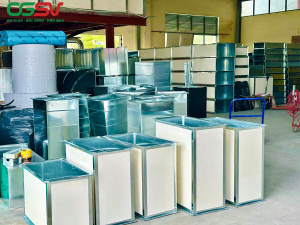
Diagram: A central air handling unit (AHU or PAU - Primary Air Unit) is placed on the roof or technical room, sucks in large quantities of fresh air, processes it (filters dust, pre-cools/heats, dehumidifies) and then pushes it into the duct system (such as galvanized steel ducts provided by onggiosaoviet.vn) to distribute to each area through air vents.
-
Advantage: Fresh air supply is synchronized for the entire project, air quality is well treated, centralized management.
-
Disadvantages: High investment cost, requires large space for pipe installation and technical room.
3.3. Heat Recovery Ventilation System (HRV/ERV) – The most modern trend
This is the most optimal solution today and is the focus of the packages. consulting on fresh air supply diagram design high-class.
-
Principle: This system has two parallel air streams that do not mix: one that draws cold/warm exhaust air from inside the house, and one that draws hot/cold fresh air from outside. They meet at the Heat Exchanger. Here, the exhaust air stream transfers heat (and humidity for ERVs) to the fresh air stream.
-
Outstanding advantages:
-
Energy saving: Recovers up to 70-80% of heat energy, helping the air conditioner not to work too hard to cool/heat the incoming fresh air.
-
Effective air filtration: Modern ERV devices often incorporate HEPA filters, which remove PM2.5 fine dust.
-
Moisture balance (with ERV): Helps prevent indoor air from being too dry when using air conditioning or too humid during the wet season.
-
4. Consulting process for designing standard fresh air supply diagram
A professional workflow ensures the system operates as expected.
-
Survey and data collection: Engineers visit the site or study architectural drawings, determine the function of each room, number of users, house direction, and potential sources of pollution.
-
Ventilation load calculation: Apply standards (TCVN, ASHRAE) to calculate the total fresh air flow required and the amount of exhaust air required for each area.
-
Plan and select equipment: Based on the investor's calculation and budget, propose solutions (Local, central or ERV). Choose machine capacity, duct type (round, square, spiral), and suitable air vent type. Quality products from onggiosaoviet.vn and dieuhoasaoviet.vn is usually the preferred choice.
-
Design schematic diagram and construction drawings (Shopdrawing):
-
Schematic diagram: Shows how the air flows and flows.
-
Construction drawings: Show in detail the machine installation location, duct path, duct size at each section to ensure wind speed, location and size of inlet/outlet doors, hanging and sound absorption details.
-
-
Technical description and quotation: Clearly explain the design plan, reasons for choosing equipment and detailed investment costs.
5. Golden notes when designing and constructing fresh air supply diagrams
To keep the system running efficiently and effectively, in addition to consulting on fresh air supply diagram design Yes, construction process needs to note:
5.1. Optimizing ductwork and air vent locations
-
Pipeline: Go as straight as possible, minimize sharp corners that cause pressure loss and wind noise. Use standard duct accessories (coil, tee, Y, tee) from reputable suppliers such as Sao Viet.
-
Air vent: Arrange the fresh air supply and exhaust vents opposite each other in the room to create a cross-flow, sweeping away stale air. Avoid arranging the fresh air supply vent right next to the air conditioner's intake vent or right at the entrance door, reducing efficiency.
5.2. Noise and insulation issues
-
The fan system and the air flow moving in the duct can be noisy. It is necessary to design and install additional sound-absorbing boxes, using flexible air ducts with sound insulation at the ends connecting to the air vents.
-
For fresh air supply systems (treated) or ERV systems, the supply air ducts need to be carefully insulated to avoid condensation and mold on the plaster ceiling.
5.3. Maintainability and cleaning
The design must take into account the future. Ceiling inspection holes should be arranged at the machine location, flow control valves (VCD, OBD) for easy access, filter cleaning and periodic maintenance. A system that is too closed will become a breeding ground for bacteria after a period of operation if it cannot be cleaned.
6. Conclusion
Investing in a fresh air system is an investment in long-term health. A process consulting on fresh air supply diagram design A systematic and scientific approach not only solves urgent problems immediately but also creates a clean, energy-saving and sustainable living environment.
Don’t let lack of technical knowledge affect the quality of your living space. Seek out professional units with extensive experience in both air conditioning equipment and duct systems (such as the solutions provided by DieuHoaSaoViet and OngGioSaoViet) to receive accurate advice and the most optimal solution for your project. An accurate design drawing from the beginning is the key to a perfect ventilation system.
CONTACT INFORMATION – SAO VIET AIR DUCT MANUFACTURING AND TRADING COMPANY LIMITED
-
Factory address: 267 Le Thanh Tong, May Chai, Ngo Quyen, Hai Phong
-
Hotline/Zalo:
-
Mrs. Hang: 0815.999.826
-
Mrs. Giang: 0934.559.168
-
Mrs. Linh: 0949.852.886
-
Tel: 0985.239.838
-
-
-
E-mail: vietonggio@gmail.com / dieuhoasaoviet@gmail.com
-
Website: onggiosaoviet.vn - dieuhoasaoviet.vn
Let Sao Viet Air Ducts be your partner in creating healthy and safe living spaces!