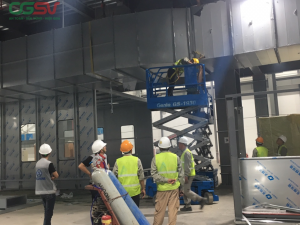
Flexible duct, or flexible duct – is a material with a structure made of steel wire in a coiled shape like a spring. This is a very popular tool in the ventilation system, often used to convey treated air. To achieve the best efficiency, it is necessary to choose the right standard size as well as have the correct installation method. Below, Sao Viet Air Duct will share with you more detailed information about the size as well as how to use and install this type of duct.
1. Structure of flexible duct
Flexible air ducts are designed in the form of a spring coil and are covered with aluminum foil on the outside. The materials used to produce flexible air ducts are soft and bendable materials such as: soft plastic, aluminum, fabric, etc.
The structure of flexible ducts usually has 3 layers, commonly used thanks to the outstanding feature of insulation, so it is also called insulated flexible ducts. Besides, there is also a type of non-insulated flexible duct with a design of only 2 layers.
The main advantages of this type of duct are: reasonable price, easy to install, easy to bend, easy to wire, easy to maintain. At the same time, this material also has good insulation properties and limits air leakage, helping to save energy. The size of the flexible duct is also very diverse to meet the installation requirements for each project and space.
2. Standard sizes of flexible ducts
Currently, the standard sizes of flexible ventilation ducts are often classified in 2 ways:
- Insulated flexible duct: This type has a cross-section of pipe from D100 - D450, standard length from 5 - 10m.
- Uninsulated flexible duct: Has a larger cross-section, about D100 - D500, each pipe length is 10m.
It is not natural that the size of the flexible duct has standards that need to be followed when installing. Especially when designing and constructing flexible ducts, special attention must be paid. Because the size of the flexible ventilation duct will be somewhat limited in length when designed. Therefore, if the installation system has a large length, it will easily cause the pipe to tear, causing pressure loss as well as the ability to transmit air inside the ventilation duct.
3. Some other standards to pay attention to when using flexible ducts
Besides size, to help the ventilation pipe operate to its maximum, it is necessary to combine it with other standards:
- Standards for joints and corners of flexible ducts to create a sealed ventilation pipe that does not leak air, ensuring the best performance.
- Specific standards for flexible ducts used in fire protection systems.
- Technical standards for installation of flexible ducts.
4. Things to note when installing flexible ducts
- Ensure all criteria for bending and size of flexible duct are correct for each type.
- Do not install flexible ventilation pipes through the wall. Because then the pipe will not stay straight but will bend quite a lot, directly affecting the system's performance.
- When joining pipes together, it is necessary to ensure absolute airtightness. The better the joints fit together, the less air is lost, helping to increase work efficiency.
- You should choose the right standard racks to have good load-bearing capacity.
- It is necessary to design and install flexible air ducts in open and neat spaces, convenient for maintenance and repair when needed.
Above is the information you need to know about standard sizes as well as things to note when installing flexible ducts. Hopefully this information will help you easily choose and install ducts.
If you need to find a professional and reputable duct manufacturing, construction and installation unit in Hai Phong, please contact us. With the motto "Building trust with quality", Sao Viet Air Duct confident to satisfy customers.
SAO VIET AIR DUCT MANUFACTURING AND TRADING COMPANY LIMITED
– Address: 267 Le Thanh Tong, May Chai, Ngo Quyen, Hai Phong
– Hotline: Mrs. Hang 0985 239 838, Mrs. Giang: 0934 559 168
– Phone: 0225 355 5619
– Email: dieuhoasaoviet@gmail.com
– Facebook: https://www.facebook.com/dieuhoasaoviet68