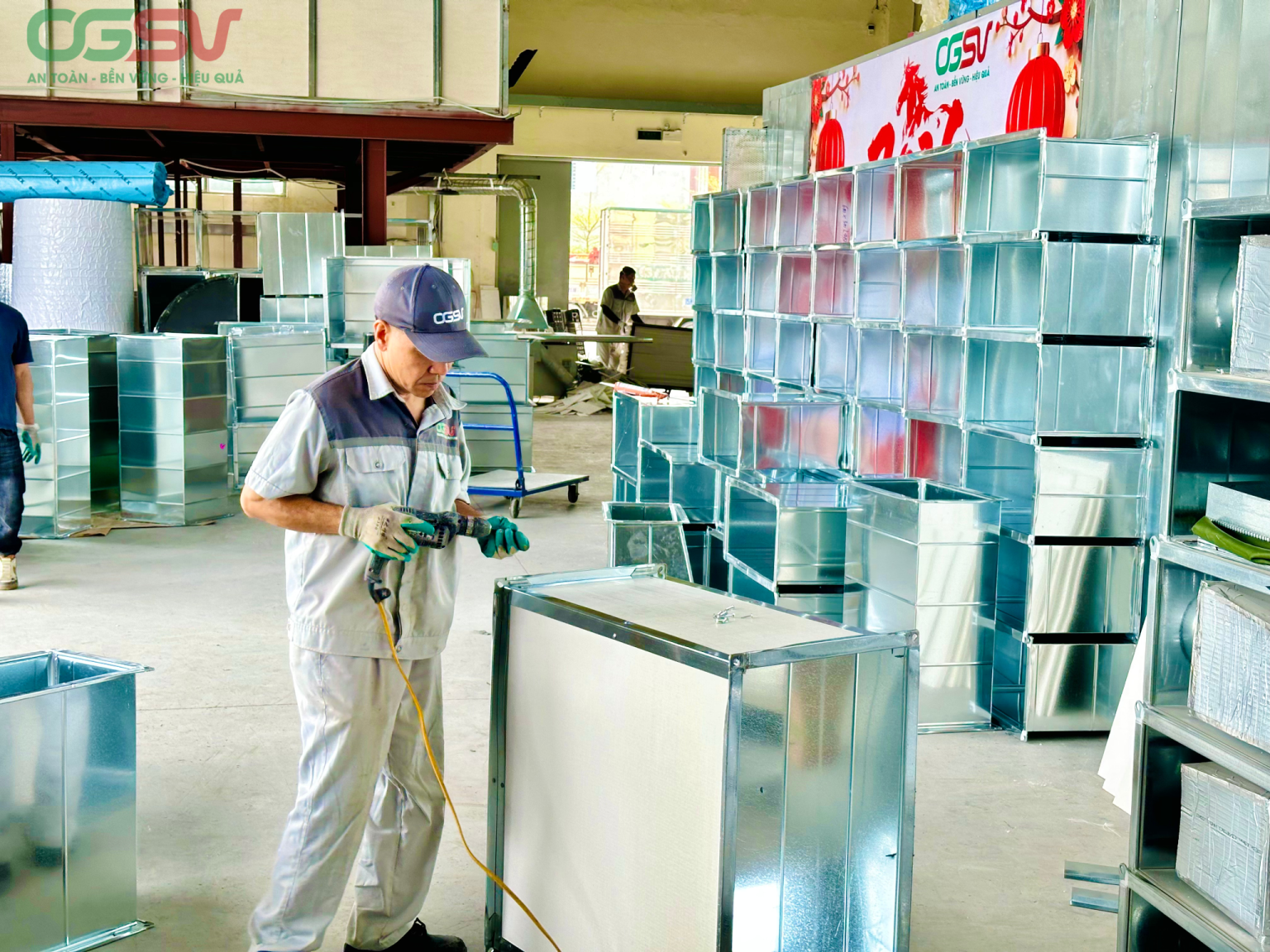
During HVAC system installation, controlling the tightness of the duct network is one of the factors that directly affects operational efficiency. A system fabricated to the correct dimensions but with numerous leaks can still reduce airflow efficiency, increase fan load, and cause difficulties during acceptance testing.
For M&E and fire protection contractors, detecting leaks as early as possible helps minimize dismantling, repairs, and on-site labor costs. Therefore, from the fabrication, transportation, and installation stages, ductwork connections need to be systematically monitored.
1. Why can air ducts leak?
Leaks don't necessarily originate from the pipe itself. In fact, many sensitive areas are located at the pipe joints.
Some common causes include:
- The joints between the pipe sections are not airtight.
- The wall is misaligned or unevenly connected.
- The corner flange has a gap.
- The accessories are the wrong size.
- The connection point to the device has not been properly addressed.
- The access hatch or technical opening is not airtight.
- The pipe was deformed during transportation.

2. 7 areas contractors should check
| Inspection location | Common risks | Content to be checked |
|---|---|---|
| Pipe joint | Slit | Check the entire perimeter. |
| Bich | Crooked, bent | Check for uniformity |
| Wall corner | Corner gap | Check the link |
| Go, turn, move | Incorrect size | Compare with the drawings. |
| Connecting the device | Loose joint | Check the contact point. |
| Visitor Gate | Untight | Check the opening and closing mechanism. |
| Through walls/floors | Open around | Complete check |
3. Precision machining helps reduce risk from the outset.
This is why contractors should not evaluate suppliers based solely on unit price.
A professional outsourcing unit needs to control both simultaneously:
- Size.
- Squareness.
- Flatness.
- Position of the flange.
- Accessory dimensions.
- Joint specifications.
- Product condition before shipment.
Sao Viet Air Duct The aim is to control the product from the initial drawing acceptance to manufacturing and delivery, thereby helping contractors minimize the need for on-site modifications.
4. Defects should not only be discovered during acceptance testing.
If we wait until the acceptance testing phase to inspect the entire system, the repair costs could increase significantly.
The contractor should conduct inspections in stages:
Processing → In-factory QC → Delivery → Installation → Final inspection → Acceptance testing.
Conclusion
The airtightness of a duct system is the result of a whole chain from design and fabrication to installation. The selection Sao Viet air duct We should not only look at the final product but also at the ability to coordinate with the contractor throughout the project execution.
Contact information
SAO VIET AIR DUCT MANUFACTURING AND TRADING COMPANY LIMITED
- Address: 267 Le Thanh Tong Street, May Chai Ward, Ngo Quyen District, Hai Phong City.
- Hotline: 0815.999.826 (Mrs. Hang) – 0934.559.168 (Mrs. Giang)
- E-mail: vietonggio@gmail.com