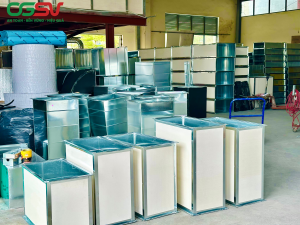
Instructions for controlling dust, foreign matter, and damage to duct ends during site preparation before installation.

After fabrication, ductwork may need to wait at the construction site before installation. During this time, the exposed duct ends are vulnerable to dust, water, construction materials, or foreign objects. Improper protection not only increases cleaning time but can also affect the internal quality of the ductwork, especially in projects requiring high cleanliness standards.
1. Why is it necessary to protect the pipe ends?
The open end of the pipe allows dust and foreign objects to enter. Rainwater or moisture can contaminate the surface and affect the material, depending on storage conditions. During transport, the pipe end may also be subjected to impacts, dents, or deformation, making joining difficult.
2. Principles of assembly at the construction site
The storage area should be dry, level, and protected from transport flows that could cause collisions. Products must be properly supported, and stacked beyond their load capacity or causing deformation. Pipe ends should be appropriately shielded while still ensuring product identification and pre-installation inspection.

3. Inspect before installing on the ceiling.
The construction team should inspect the condition of the pipe ends, the visible inner surfaces, the joints, and the connection points. If water, dust, or foreign objects are detected, they must be cleaned according to appropriate procedures before connection. An uninspected pipe section should not be installed immediately just to meet deadlines.
4. Inventory and Pre-Installation Checklist
This list can be used in an internal delivery checklist.
| Time | Content of the test | Control methods |
| Upon receiving the goods | Quantity, item code, dents, and condition of the pipe ends. | Compare the delivery slip and note any anomalies. |
| When assembling | Platform, dryness, risk of impact | Set up a separate area, protected from water and falling materials. |
| While waiting | Product shielding and identification | Regular checks are necessary, and labels must not be lost. |
| Before installation | Dust, foreign objects, connectors, and pipe edges. | Clean, repair, or call a technician if necessary. |
| After assembling each section | Remaining open head condition | Temporarily cover the unconnected ends. |
Conclusion
Protecting the ends of air ducts is a simple task, but it significantly impacts construction quality and completion time. When responsibilities for gathering, covering, and inspecting materials are clearly assigned, contractors can prevent many small errors from accumulating into major problems.
Contact Sao Viet Air Ducting
Sao Viet Air Ducting recommends that contractors standardize the process of product delivery, collection, and inspection from the outset. For project orders, clear product coding and delivery plans facilitate better material control.
SAO VIET AIR DUCT MANUFACTURING AND TRADING COMPANY LIMITED
Address: 267 Le Thanh Tong, May Chai, Hai Phong
Hanoi Representative Office: No. 19, Lane 24, Kim Dong Street, Giap Bat Ward, Hoang Mai District, Hanoi
Hotline: 0815.999.826 – 0934.559.168 | Technical support: 0949.852.886
Email: vietonggio@gmail.com