Air conditioning and ventilation (HVAC) systems are considered the "lungs" of shopping malls – places with large spaces, high crowds, and continuous operation. Choosing the wrong ventilation system not only wastes billions of dong in operating costs but also directly impacts the customer's shopping experience.
Currently, the competition between Fabric air ducts (representing a new technological solution) and sheet metal air ducts Galvanizing (the traditional solution) remains a topic of particular interest to investors and M&E engineers. Let's delve deeper into the technical aspects below to find the optimal solution.
1. Air Distribution Mechanism and Soundproofing Standards
A high-end shopping space requires a smooth, evenly cool airflow and absolutely no technical noise.
- For fabric air ducts: The entire duct acts as a giant air vent. Air is diffused outwards through millions of tiny holes (micro-perforation) precisely calculated by software. Thanks to this mechanism, the shopping mall will not experience strong drafts causing localized chill. The nature of the technical fabric material also naturally eliminates airflow noise without the need for additional soundproofing boxes.
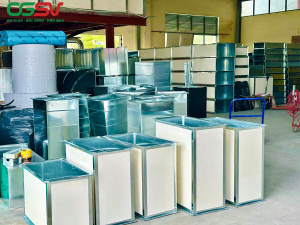
- For sheet metal ducting: Cold air travels along the ductwork and exits through fixed vents (Anemostat/Diffuser). The air pressure at these vents is often very high, easily causing a slight humming sound. If the airflow is not calculated accurately, the shopping mall will experience a situation where some areas are too cold, while others are stuffy.

2. Open Ceiling Aesthetics and Structural Loads
The current trend in shopping mall architecture is to use open ceilings (instead of plasterboard ceilings) in supermarket and food court areas to create a sense of spaciousness and airiness.
- Fabric air ducts: The biggest advantage is the diverse color palette, allowing for dyeing to match brand identity or the ceiling paint. In terms of weight, the fabric tubes are extremely light (only about 0.1 – 0.3 kg/m2), minimizing the static load on the shopping mall's ceiling system.
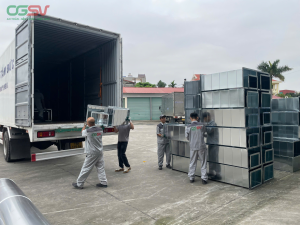
- Sheet metal air ducts: The pipes have a rustic, industrial style. However, if the insulation (fiberglass wool, vulcanized rubber) on the outside is not properly applied, condensation can easily form, causing drips onto the floor, which is unsightly and dangerous for pedestrians. The heavy weight of the metal pipes requires a complex suspension system and support brackets.
3. Technical Advantages and Disadvantages Analysis Table
| Evaluation Criteria | Fabric Duct Solutions | Galvanized Steel Duct Solutions |
| Mechanical strength | 10-15 years (May tear if punctured by a sharp object) | Over 20 years old (Durable, highly resistant to mechanical impact) |
| Regular cleaning | It's very easy: Remove the zippers and put them in an industrial washing machine to clean off fine dust and disinfect. | Very difficult: Specialized cleaning robots have to be used to get inside the pipes, and the maintenance costs are very high. |
| Construction time | Reduce 70% time (Simply position the cable car and pull the hose). | It takes longer and requires more workers for assembly, screwing in fasteners, and applying insulation. |
| Fire safety standards | Meets international fire resistance certifications such as EN 13501 (Class B-s1, d0). | Meets high fire resistance standards.EI duct) when covered with an additional specialized fire-resistant layer. |
4. Economic Problem: Total Investment Cost
Many investors often mistakenly believe that fabric conduit is more expensive than metal conduit. In reality, when bidding on shopping mall projects, we need to compare the total cost of the system (including materials + labor + accessories):
- The purchase price of high-quality imported fabric conduit is usually equivalent to or higher than that of raw galvanized steel.
- However, the fabric tube No insulation needed., No air vents needed. and super fast construction.
- As a result, the total cost of completing a fabric duct system is typically... Save from 15% – 25% compared to a fully insulated galvanized steel pipe system.
Optimal Coordination Plan for the Shopping Mall Project
To achieve the best results in terms of both functionality and budget, the current trend in HVAC design for shopping malls is: Hybrid model combination:
- Use fabric air ducts for large public spaces: General retail areas, hypermarkets, reception lobbies, cinemas, and entertainment areas require even, aesthetically pleasing ventilation and open ceilings.
- Use galvanized steel ducting for technical and safety areas: The central machine room (chiller, AHU), vertical ventilation ducts concealed in technical shafts, and especially the corridor and basement smoke extraction systems are mandatory. Fireproof duct (EI ductwork) for fire safety inspection.
This intelligent allocation will help investors optimize cash flow while owning a modern, safe, and smoothly operating shopping mall.
>>> See more: Get free technical advice and a quote!
Protect your building proactively today with a standard fire-resistant ventilation system. Contact Sao Viet now for expert advice and the best price quote.
Address: 267 Le Thanh Tong, May Chai, Hai Phong
Mrs. Hang: 0815.999.826
Mrs Giang: 0934.559.168
E-mail: vietonggio@gmail.com