
Designing HVAC systems for large buildings requires a balance between engineering and cost. Choosing duct sizes that are too small will result in increased airflow velocity, causing whistling noise and a drop in dynamic pressure. Conversely, ducts that are too large will increase material costs and occupy more false ceiling space.
Below is a three-step process for determining duct size based on the Velocity Reduction method, commonly applied in design practice.
1. Three-Step Process for Calculating Actual Duct Size
Step 1: Determine the airflow rate (Q)
The total airflow rate (in m3/h) is calculated in advance based on the cooling load of the space (for central air conditioning systems) or based on the air exchange rate (for fresh air supply or smoke extraction ventilation systems for corridors and basements).
Step 2: Select the wind speed limit (v)
Depending on the duct placement and noise control requirements of each area, the design engineer will select the appropriate wind speed according to ASHRAE or TCVN 5687 standards.
The typical economic wind speed is defined as follows:
- Main duct: Air velocity from 6.0 to 9.0 m/s (Applicable to office buildings and shopping malls).
- Branch duct: Air velocity from 4.0 to 6.0 m/s.
- Flexible ducting connected directly to the air vent: Velocity from 2.0 to 3.0 m/s.
Step 3: Determine the dimensions of the geometric cross-section.
From the selected flow rate and velocity, the cross-sectional area of the air duct (A) is determined by dividing the airflow rate by the velocity (with time units converted from hours to seconds).
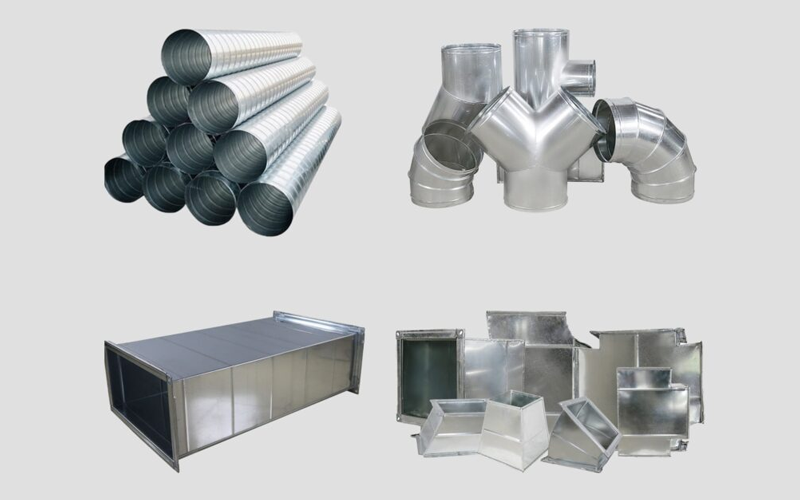
- For spiral round ducting: Calculate the standard duct diameter for the factory from the cross-sectional area.
- For square or rectangular ductwork: Engineers will pre-determine one dimension of the duct (usually height H) based on the allowable clear opening of the drywall ceiling. Then, the remaining width W is calculated by dividing the area by the height. The optimal W:H ratio should be less than 4:1 for stable airflow.
2. Quick Reference Table for Duct Sizes Based on Flow Rate
To save time on manual calculations, engineers can quickly look up the dimensions of commonly used rectangular ductwork in office design using the table below (assuming main duct velocity of 7.5 m/s and branch duct velocity of 5.0 m/s):
| Airflow Rate (Q) (m3/h) | Wind Speed (v) (m/s) | Air Duct Dimensions W x H (mm) |
| 500 – 800 | 4.5 (Branch pipe) | 200 x 200 |
| 1000 – 1500 | 5.0 (Branch pipe) | 300 x 250 |
| 2500 – 3500 | 7.0 (Main pipe) | 400 x 300 |
| 4500 – 6000 | 7.5 (Main pipe) | 600 x 350 |
| 8000 – 10000 | 8.0 (Main pipe) | 800 x 400 |
3. Technical Considerations When Re-inspecting the Pipeline
- Static pressure loss: The longer the pipeline and the more elbows and bends are used, the greater the static pressure loss. After finalizing the geometric dimensions, the pressure loss per meter length should be checked again using a Ductulator or Duct Checker software; the safe limit ranges from 0.8 to 1.2 Pa/m.
- Reduced cone angle: When reducing the size from the main pipe section to the branch pipe, the cone angle should not exceed 15 degrees to avoid air turbulence creating dynamic resistance.
Conclusion
Accurately determining the correct duct size is crucial for ensuring the entire HVAC system operates at its designed capacity, preventing leaks and eliminating noise. Besides precise calculations, selecting a reputable precision fabrication company also ensures that on-site installation perfectly matches the design drawings.
If you need more detailed advice on construction methods or want a quote for high-quality ductwork for your project, please contact Sao Viet immediately for prompt technical support.
>>> See more: Get free technical advice and a quote!
If you are looking for a reliable ducting supplier that guarantees safety, durability, and efficiency for your project in Hai Phong and surrounding provinces, please contact us immediately:
Address: 267 Le Thanh Tong, May Chai, Hai Phong
Mrs. Hang: 0815.999.826
Mrs Giang: 0934.559.168
E-mail: vietonggio@gmail.com