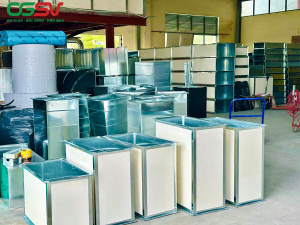

Workers operate the automated sheet metal cutting and processing line at the Sao Viet Ducting Factory.In HVAC, air conditioning, ventilation, and cleanroom projects, the quality and delivery time of ductwork are extremely important. To meet the growing demands of factory projects, shopping malls, and high-rise buildings, many companies have invested in automated ductwork production lines at their factories. This modern process not only improves product quality but also demonstrates the ability to supply large quantities in a short time.
Why is an automated duct production line needed?
In large-scale projects such as industrial plants, hospitals, shopping malls, or office buildings, duct systems often involve a very large volume of material. Using manual fabrication methods would result in slow production, inconsistent accuracy, and difficulty in ensuring quality.
Investing in an automated duct production line offers several significant benefits:
- Increase production efficiency many times over compared to manual processing.
- Ensuring high precision in every detail of the ductwork.
- Reducing technical errors speeds up on-site installation.
- Fulfilling large-volume orders for large-scale projects.
As a result, modern duct manufacturing plants can supply thousands of square meters of ducting every day while still ensuring technical standards.
Automated duct manufacturing process at the factory.
A professional HVAC duct manufacturing process typically follows these standard steps:
Step 1 – Prepare the materials
The main materials used to manufacture air ducts are galvanized steel or stainless steel that meet technical standards. The materials are inspected for thickness, flatness, and plating quality before being processed on the production line.
Material control helps ensure the durability, corrosion resistance, and lifespan of the duct system.
Step 2 – Automatic cutting and shaping
Sheet metal is fed into a CNC cutting machine or an automatic plasma cutting machine to create precise dimensions according to the technical drawings. Then, the material is transferred to an automatic forming and seaming system.
This step helps to:
- Increase production speed.
- Reduce dimensional errors.
- Ensure the air duct is airtight.
This is a crucial step in the mass production of industrial ductwork.
Step 3 – Machining the flange and joining
After shaping, the ductwork is processed with flanges, stiffening ribs, and connecting details. Automated equipment helps ensure stability during installation in HVAC systems.
Precise fabrication ensures stable operation of the duct system, minimizes air leaks, and reduces energy loss.
Step 4 – Quality control and finalization
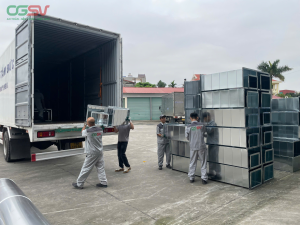
Before shipment, products undergo checks for dimensions, tightness, flatness, and technical specifications. Only products that meet the requirements are packaged and transported to the construction site.
A rigorous inspection process ensures high-quality HVAC ductwork that meets the construction standards of major projects.

Capacity to supply large quantities for projects
Thanks to the application of automated duct manufacturing technology, many factories can now:
- Mass production in a short time
- Simultaneously managing multiple large projects.
- Ensuring construction progress and product quality.
This is a crucial factor that helps HVAC contractors assert their production and supply capabilities in the market.
Conclude
Investing in an automated duct production line at the factory not only improves product quality but also demonstrates the capacity to supply large-scale projects. With a modern production process, strict quality control, and high productivity, duct manufacturers can fully meet the stringent requirements of the HVAC and industrial ventilation systems industry.